
Maths
Caring Respect Empathy Courage Resilience


Subject Leader: Mrs Weatherby
Mastering Number
Mastering Number is an initiative designed to ensure that all children develop strong foundational skills in number sense as they progress from Reception through to Year 1 and Year 2. The programme focuses on instilling a deep understanding of numbers, calculations, and their practical applications, thereby enabling children to approach mathematical concepts with confidence and competence.
The overarching aim is for children to leave Key Stage 1 (KS1) with a high level of fluency in calculation, which includes not just the ability to perform basic mathematical operations, but also a flexibility in their numerical thinking. This flexibility allows them to tackle problems with various strategies and adapt to different mathematical situations. By fostering these skills, Mastering Number ensures that children are well-prepared for the more complex mathematical challenges they will face in later years.
Particular attention will be given to the key knowledge and understanding that are essential for children in Reception classes, such as recognising numbers, understanding their values, and the basics of addition and subtraction. As children progress through KS1, the programme will provide a structured approach that builds on their prior knowledge, ensuring a smooth progression and reinforcing learning at every stage. This carefully sequenced approach will set the foundation for mathematical success in future educational pursuits.
Mastering Number in Year 3
Mastering Number in Year 3 is designed to build deep number sense, fluency, and flexibility beyond basic counting, establishing strong foundations for later maths by focusing on number composition, part-whole relationships, subitising, and reasoning (e.g., always/sometimes/never statements), using concrete-pictorial-abstract (CPA) methods and repetition to create confident, conceptual thinkers, not just counters. It tackles gaps from earlier years, making all children confident with numbers up to 20 and beyond, ready for complex calculations.
Our Intent
The intent of our Primary Mathematics curriculum at Merton Bank is to deliver an engaging, balanced mathematics curriculum which is accessible to all and that will maximise outcomes for every child so that they know more, remember more and understand more. Our aim is to deliver quality teaching that will enable each and every one of our pupils at Merton Bank to become a mathematician, who can confidently apply their skills to everyday situations.
The aims of Maths at Merton Bank are:
- To promote enjoyment and enthusiasm for learning mathematics through practical activity, exploration and discussion;
- To develop logical thinking and reasoning skills through a natural curiosity and investigative approach and the ability to verbalise their reasoning;
- To promote confidence, independence and competence in mathematics and in applying mathematics;
- To develop a thorough knowledge and understanding of numbers and the number system;
- To develop the ability to solve problems through decision-making and reasoning in a range of contexts;
- To develop a practical understanding of the ways in which information is gathered and presented;
- To explore features of shape and space, to develop spatial awareness and develop measuring skills in a range of contexts;
- To know by heart number facts and bonds that are required to be known by heart;
- To understand the importance of mathematical skills in everyday life.
Implementation:
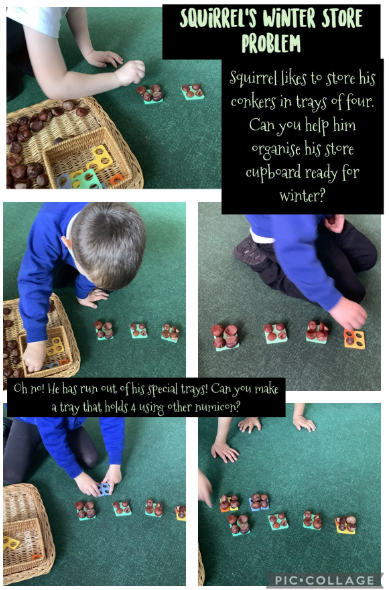
At Merton Bank, our teaching of Mathematics begins in the Early Years, where children are introduced to key mathematical concepts. Practitioners recognise that maths needs to be explicitly taught before pupils can be access it in exploration and discovery within the continuous provision. Carefully chosen stories provide a ‘hook’ for learning in daily Maths meetings, allowing quality maths talk and mathematical thinking to take place. Maths Mastery resources from NCETM and White Rose Maths schemes are used in conjunction with each other to provide a high-quality Early Years Maths curriculum, which is based on the needs of our learners.
Mathematics teaching in KS1 and KS2 builds on the firm foundations set in the Early Years. At Merton Bank, we follow The White Rose Maths schemes of learning, which support a mastery approach to teaching and learning and are consistent with the aims and objectives of the National Curriculum.
At Merton Bank, our teaching of Mathematics follows the concrete, pictorial, abstract approach so that our pupils gain a secure understanding during their learning.
Concrete
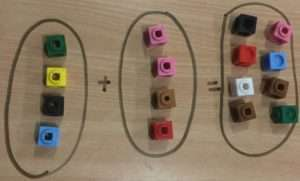
During the concrete stage, pupils have the opportunity to use concrete objects and manipulatives, such as cubes, numicon or counters to help them understand what they are doing.
Pictorial
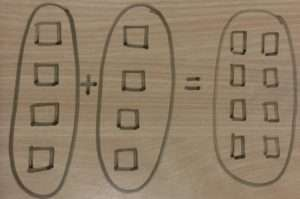
At the pictorial stage, pupils then build on their concrete experience by using pictorial representations, for example using or drawing a number line, drawing a picture to help solve a problem or using pictorial representations of the concrete materials used previously.
Abstract

With the foundations firmly laid in the concrete and pictorial stages, pupils are then able to move to an abstract approach using numbers and key concepts with confidence.
IMPACT:
The impact of mathematics teaching at Merton Bank is monitored regularly as part of our monitoring cycle. As a school, we are continually committed to raising standards, establishing high expectations, and promoting effective teaching and learning and monitoring is a pivotal part of this process. Evaluating the information gathered from learning walks, book monitoring, pupil voice, staff feedback and maths surgeries enable good practice to be shared and identify where further improvements need to be made.
Assessment can be summative or formative. Both types are used to full benefit at Merton Bank Primary School. Teachers assess on a daily basis, then they use that information to plan the next steps for individuals or groups of children, ensuring that the lessons are pitched at the correct level of challenge. Half termly tests are conducted and analysed; the analysis is then used to narrow any gaps in learning. End of year assessments and RAISEOnline aid analysis and measurement of progress. End of Key Stage tests are conducted in accordance with the latest guidance and requirements. Data is recorded into tracking programs, which is then used for target setting procedures to form the basis for medium and long-term targets for teaching and learning. Assessment is made of all areas of maths: calculation skills, number knowledge and skills, shape and space knowledge, handling data skills and applying mathematics, amongst other facts and knowledge learned.
Fast Maths
Fast Maths was introduced at the start of Autumn term 2025 in KS2. This is in addition to our Maths Mastery White Rose lessons. There are three different sessions that are designed to accelerate and improve pupils’ knowledge, fluency, speed and recall of multiplication tables and also give them the skills to manipulate facts that they know to find other facts.
Useful Maths Links
|
https://whiteroseeducation.com/1-minute-maths |
|
|


